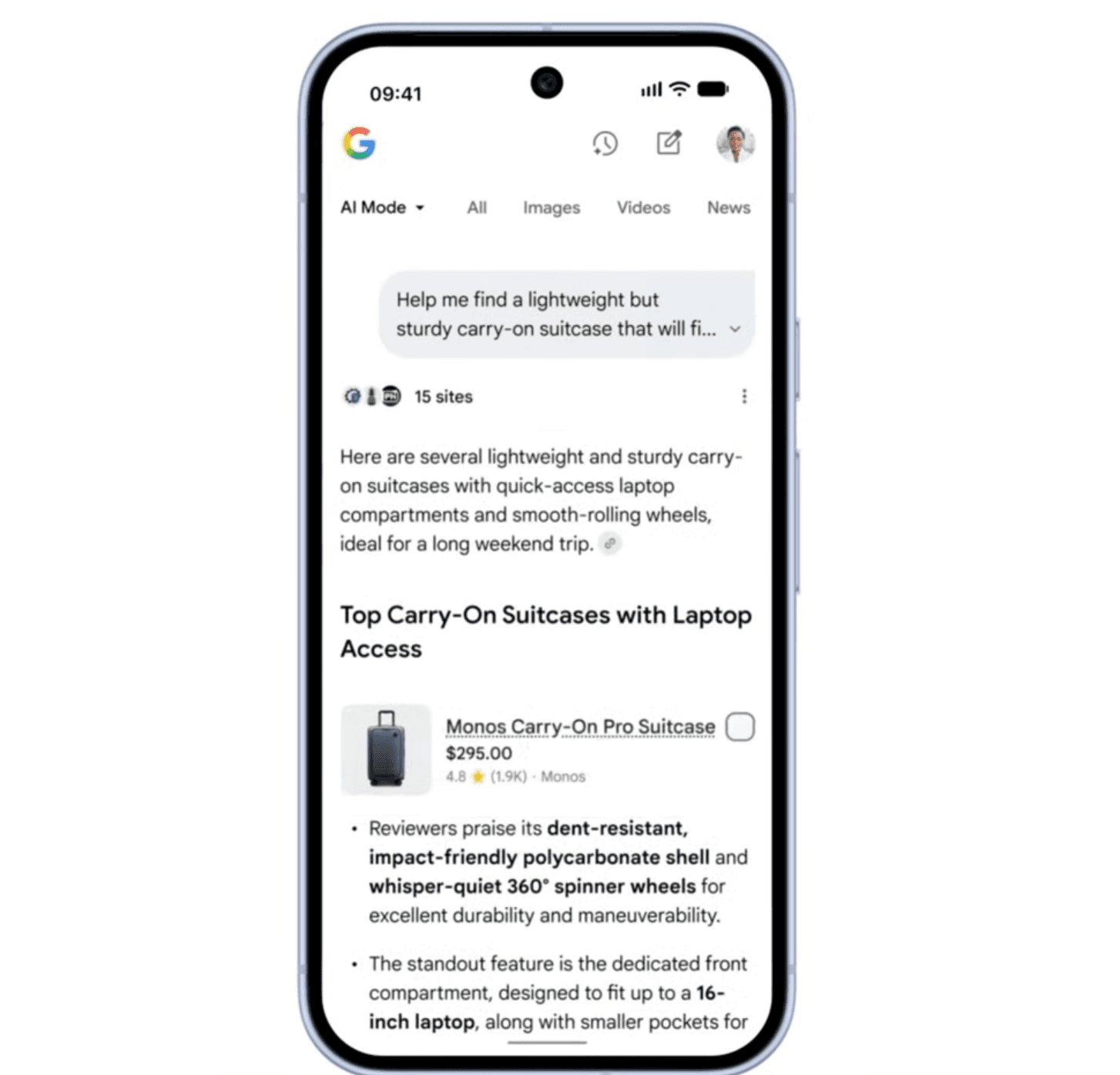


Something is changing in how the world shops, and it is arriving faster than the shifts before it. Shoppers are starting to ask an AI agent what to buy, and the agent is starting to answer. For retailers, this is the biggest change since the internet itself. The difference this time is how little warning comes with it.
It is already happening
This is not a forecast. AI-referred traffic to retail sites grew 693% over the 2025 holiday season, and it converts 31% higher than any other source (Adobe Analytics, early 2026). Google’s agent-led checkout went live in January 2026. The shoppers using it are not waiting for anyone to be ready.
Most retail teams already know this. Awareness is not the problem. The problem is the distance between knowing agentic commerce is coming and being positioned to thrive in it. Those are two different things, and the gap between them is where the next few years of retail will be won or lost.
The gap almost nobody is measuring
An AI shopping agent does not browse your store the way a person does. It reads your product page directly, and it reads what is there the moment the page first responds. It does not wait for anything else to load.
That matters, because most modern ecommerce pages do not arrive all at once. The page responds, and then it assembles itself. For a shopper in a browser this happens invisibly, and the finished page looks correct. For an agent, only that first response is visible. If the product information is not there in that moment, then as far as the agent is concerned it is not there at all.
So a retailer can have an accurate, well-maintained catalogue and still have products that are invisible to the agents shopping on their customers’ behalf. Adobe found that 33% of retail product content is already unreadable to AI. That is a third of the shelf that cannot be chosen, not because the products are worse, but because the agent cannot read them.
Why it stays hidden
This gap survives because it does not sit in any one team’s remit. Marketing is watching search. Whoever owns Merchant Center is watching the numbers Merchant Center shows, and this is not one of them. Engineering may not know it exists. The tools most teams rely on were built for browsers, where the whole page finishes before anything judges it. They do that job well. They were never built for a reader that judges the first response and moves on.
The question worth asking
The useful question is not “are we compliant on Merchant Center?” That is worth knowing, but it is a different question. The real one is simpler: when an AI shopping agent reads one of our product pages, what does it actually find? Most retailers do not know, and almost none have tested it. That is where readiness begins.
What to do about it
Zero Drift, by souksense, makes your products readable to AI shopping agents. It watches your live pages against your product feed, so a mismatch gets flagged the moment it appears, before it costs you a sale. No code, no developer, nothing for your team to rebuild. Readable means the agent can see you. No tool can promise it will recommend you, but nothing can recommend what it cannot read.
You're one call away from making sure AI knows you exist.
We'll show you what AI shoppers can read about your products today, and what they can't.
Book a call